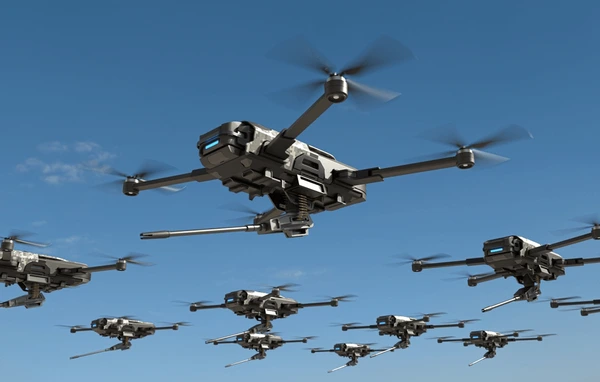
How inexpensive drones are reshaping security across the region
A $20,000 drone can now shut down a $20 billion airport.
That imbalance—tiny cost, massive disruption—is quietly reshaping modern conflict. What once looked like hobbyist technology has become a strategic tool capable of challenging militaries, closing airspace, and rattling global markets. The latest confrontation involving Iran and its regional rivals shows just how quickly this shift is unfolding.
Before the current crisis erupted, I spoke with Steve Haro*, CEO of WhiteFox Defense Technologies. My firm has worked alongside major U.S. defense contractors for years, but counter-drone technology was new territory for me. What struck me most in that conversation was how something small enough to fit in a backpack could suddenly challenge a nation-state.
Recent events have made that reality impossible to ignore.
When U.S. and Israeli strikes hit Iranian targets in late February, Tehran responded with waves of ballistic missiles and large drone salvos aimed at Gulf states, U.S. bases, and Western diplomatic facilities. Across Bahrain, Kuwait, Qatar, Saudi Arabia, and the United Arab Emirates, air defenses were pushed to their limits intercepting hundreds of unmanned systems.
Even successful interceptions came at a cost. Debris falling from the sky injured civilians and damaged infrastructure. In Riyadh and Kuwait City, Iranian drones struck near U.S. diplomatic compounds, forcing closures and emergency warnings.
Farther north, in the narrow shipping corridor of the Strait of Hormuz—through which roughly a fifth of global oil exports pass—fuel tankers were struck, rattling shipping routes and energy markets.
But the most important lesson from this confrontation is not simply the scale of Iran’s retaliation. It is the method.
Cheap drones.
Tehran’s use of inexpensive unmanned aerial systems in massed salvos is no longer a fringe tactic. It has become a core element of an asymmetric strategy designed to pressure rivals while avoiding the costs and risks of conventional escalation.
Small drones have fundamentally changed the economics of conflict. They are inexpensive to manufacture, easy to conceal, and difficult to attribute. They can cross sovereign airspace in minutes. And even when intercepted, they often achieve their objective by forcing expensive defensive responses and exposing vulnerabilities in critical infrastructure.
In other words, the attacker’s costs are low. The defender’s costs are high.
That imbalance is especially dangerous in the Gulf. International airports sit beside military installations. Oil terminals, desalination plants, and refineries anchor entire national economies. A single swarm attack—even one largely intercepted—can halt flights, spike insurance costs, and shake confidence in regional stability.
The vulnerability is compounded by outdated governance. Most aviation regulations were written for piloted aircraft flying at 30,000 feet. Telecommunications laws never anticipated hostile drones hovering above dense urban skylines. Even in countries with advanced air defenses, authority to detect and mitigate small drones is often fragmented across multiple agencies.
Technology moved fast. Policy did not.
Counter-drone capabilities, however, are evolving rapidly. Modern systems can identify unmanned aircraft using multiple sensing methods and, where legally permitted, redirect them or guide them safely to the ground. These non-kinetic approaches are increasingly important in urban environments, where destroying drones mid-air can create additional risks from falling debris.
Companies such as WhiteFox Defense Technologies represent this shift toward more controlled airspace security. Rather than relying solely on kinetic interception, these systems focus on detection, classification, and controlled mitigation. Similar airspace awareness technologies supported security operations during the 2022 FIFA World Cup in Qatar, where maintaining visibility over unauthorized drones near crowded venues formed part of the broader protection effort.
As Haro explains, no single sensor can detect every drone. Effective counter-drone defense relies on layered systems. Radar, electro-optical and infrared cameras, acoustic sensors, and radio-frequency analysis each reveal different aspects of the airspace. When integrated through a unified command-and-control platform, these sensors give operators a clearer picture of what is happening above them.
Mitigation must be layered as well. Non-kinetic techniques are often the safest first response, particularly around cities and critical infrastructure. But kinetic options remain necessary in some circumstances. When they are used, the method matters. Directed-energy systems such as lasers can reduce collateral risk compared with missiles that may miss their target—or ballistic defenses whose rounds must eventually return to the ground somewhere.
The goal is not simply to stop a drone, but to stop it in a way that minimizes unintended consequences for the people and infrastructure below.
But technology alone will not solve the problem.
The contest unfolding in the skies above the Middle East is as legal and diplomatic as it is technical. In many jurisdictions, even non-kinetic counter-drone tools operate in legal gray zones. Who has the authority to intervene? Under what circumstances? With what oversight?
Without clear statutory frameworks, even proportionate defensive actions risk undermining the public trust they are meant to protect.
The latest confrontation involving Iran also underscores a deeper shift. Drones are no longer just battlefield tools. They are instruments of geopolitical signaling.
They blur the line between civilian and military technology, between plausible deniability and open aggression. When they cross sovereign airspace, they test not only radar systems but legal boundaries and diplomatic resolve.
Because unmanned systems ignore borders, responses must extend beyond them. Intelligence sharing, interoperable defense systems, and agreed standards among Gulf states and Western allies can help prevent low-cost attacks from triggering high-cost crises.
History offers a useful perspective. In the twentieth century, nations fortified their coastlines. Later they built layered defenses against high-altitude bombers and ballistic missiles.
Today, the frontier has moved again.
It now hovers above airports, refineries, desalination plants, and crowded urban corridors. The sky itself has become infrastructure.
If governance does not evolve at the pace of technology, states will remain trapped in an asymmetric cycle—deploying ever more expensive defenses against ever-cheaper drones while the legal architecture meant to safeguard civilian airspace lags dangerously behind.
The drone age did not arrive with fanfare. It arrived quietly, on electric rotors.
And securing it will require more than better weapons. It will demand legal clarity, institutional coordination, and strategic imagination equal to a threat that now flies just above our heads.
*****Mr. Haro serves as President and CEO of WhiteFox Defense. With more than four decades of experience in the aerospace industry, he previously held executive leadership roles at Boeing and Mitsubishi Aircraft.****